How to Read Your PIQ Score
PIQ (Pipeline Intelligence Quotient) is a 0–100 composite score that measures how optimized your outbound pipeline is. Think of it like a credit score for your go-to-market motion: it tells you not just how you're doing, but exactly where to improve.
Why PIQ Exists
Most outbound programs fail for one of five reasons: wrong audience, weak messaging, poor infrastructure, unqualified pipeline, or slow follow-up. The PIQ framework turns each of these into a measurable dimension so you can see exactly what's working and what isn't, and track improvement over time.
The 5 Dimensions
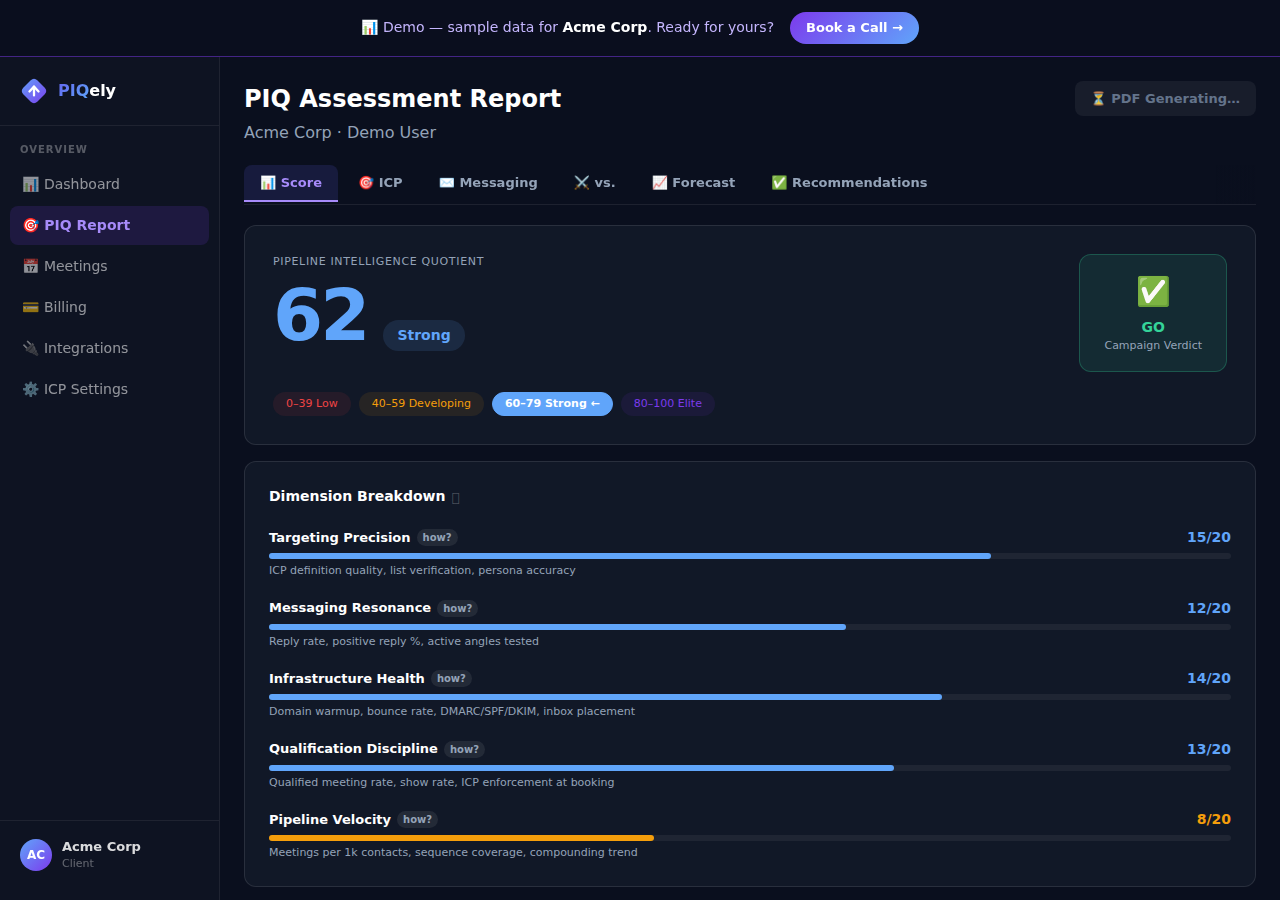
1. Targeting Precision
What it measures: How accurately your ICP (Ideal Customer Profile) aligns with your actual best customers.High score signals:
- Your ICP is narrow, specific, and validated against converted clients
- The industries and titles you're targeting have a history of converting
- Your list quality is high (low bounce rates, high open rates)
- ICP is broad or undefined ("any B2B company")
- You're targeting decision-adjacent titles rather than decision-makers
- High percentage of "Not a Fit" outcomes in your meeting log
- Reply rate above 3% (strong) or 5%+ (elite)
- Open rate above 40%
- Replies are positive or curious (not just unsubscribes)
- Reply rate below 2%
- Generic, feature-heavy messaging that doesn't connect to specific pain points
- High volume of neutral or negative replies ("not interested")
- Inbox warmup reputation at 85%+
- Bounce rate below 3%
- Spam complaint rate below 0.1%
- SMTP and IMAP connectivity green on all inboxes
- One or more inboxes flagged with deliverability issues
- Bounce rate trending upward (list quality problem)
- Spam complaint rate elevated (messaging or targeting issue)
- 80%+ of booked meetings result in Qualified status
- Low no-show rate
- Meeting outcomes skew toward Converted and Nurturing (not Not a Fit)
- High no-show rate (>20%)
- High "Not a Fit" outcome rate
- Booking prospects who aren't the real decision-maker
- Short time from reply to booking link sent (<4 hours)
- High booking rate after link is sent (>50%)
- Low time from booked to qualified (meetings happening close to scheduled time)
- Prospects going cold after receiving booking link (>7 days without booking)
- High cancellation rate
- Long gaps between reply and booking link send
Low score signals:
How it improves: Every time you log a meeting outcome (Converted, Not a Fit), Wire learns what good looks like. Over time, it shifts targeting toward higher-converting profiles.
2. Messaging Resonance
What it measures: How effectively your email copy creates genuine interest and drives replies.High score signals:
Low score signals:
How it improves: Forge (our campaign optimization agent) continuously A/B tests subject lines and email angles. Wire flags reply patterns. Low-performing angles get replaced within 2–4 weeks of data collection.
3. Infrastructure Health
What it measures: The technical health of your sending setup, including sender reputation, deliverability, bounce rates, and spam complaint rates.High score signals:
Low score signals:
How it improves: Infrastructure health stabilizes during warmup and maintains itself with consistent, disciplined sending. Piqely monitors this automatically and flags issues before they become problems.
4. Qualification Discipline
What it measures: How consistently the meetings you're booking actually match your ICP and result in real opportunities.High score signals:
Low score signals:
How it improves: As Wire gets more outcome data, it gets stricter about which replies it routes to booking. It learns to recognize the patterns that lead to qualified vs. not-fit meetings.
5. Pipeline Velocity
What it measures: How fast prospects move through your pipeline from reply to qualified meeting.High score signals:
Low score signals:
Score Benchmarks
| Score Range | Rating | What it means |
| --- | --- | --- |
| 85–100 | Elite | Fully optimized pipeline, compounding results |
| 70–84 | Strong | Good fundamentals, specific areas to sharpen |
| 55–69 | Developing | Campaign producing results, optimization underway |
| 40–54 | Early Stage | Baseline established, significant improvement runway |
| Below 40 | Needs Attention | Structural issues to address before scaling |
Typical Improvement Arc
Most clients follow a predictable trajectory:
Month 1 (First Assessment): 40–55 You're establishing baseline. Infrastructure is still warming, we don't yet have outcome data to refine targeting, and messaging is in its first iteration. This score is expected and normal.
Month 3 (Second Assessment): 60–72 Campaign is optimized, targeting has been refined based on early meeting outcomes, and messaging angles have been tested. The biggest gains usually happen here.
Month 6 (Third Assessment): 73–85 Data-driven refinement is underway. ICP is tight, messaging is proven, infrastructure is stable, and qualification discipline is high. Clients in this range consistently produce high-quality pipeline.
Month 12+: 80–95 For clients who consistently log outcomes and engage with refinement recommendations, scores in this range represent a mature, predictable outbound motion.
Where to View Your Score
Frequently Asked Questions
How often is my score updated? Scores are updated with each formal assessment. Assessments happen at Month 1 (baseline), Month 3, and quarterly thereafter. Interim updates may happen if significant campaign changes are made.
Can my score go down? Yes, though it's uncommon. A score decline typically signals a deliverability issue, a shift in reply quality, or targeting drift. Your CSM will flag this before the next formal assessment.
What's the fastest way to improve my score? Log meeting outcomes. Every Converted or Not a Fit outcome you log teaches Wire what to target and what to avoid. Clients who log outcomes consistently see 15–20 point score improvements between Month 1 and Month 3.